Exploratory Sketching
Sketching, Creativity
Exploratory Sketching (DZB120)
2021
Summary
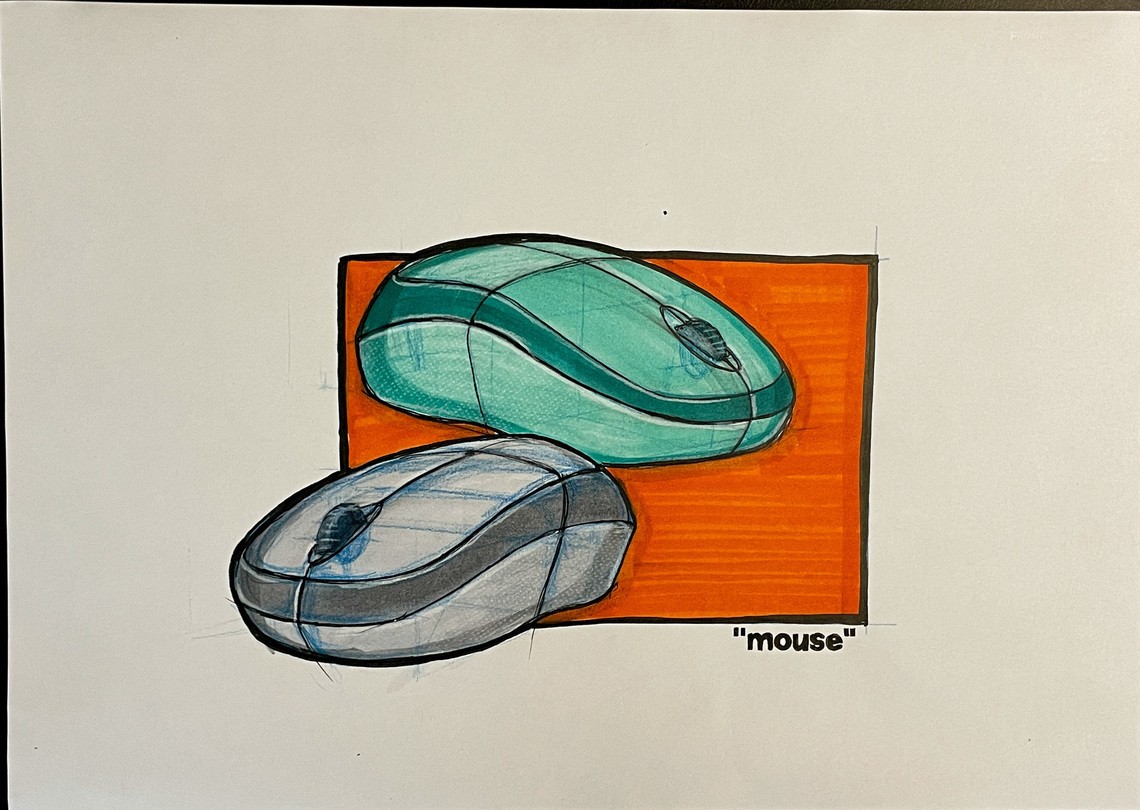
Exploratory Sketching consisted of a series of exercises focused on using hand sketching to explore, develop, and communicate industrial design concepts. The assignments progressed from fundamental techniques, such as drawing confident lines and arrows, to constructing linear and cylindrical objects, combining geometries, rendering materials, and presenting products within scenarios.
Later exercises focused on setting a scene, integrating people into sketches, working with complex geometry, and redesigning products. Together, these assignments created a visual record of my development throughout the course. They show how I moved from drawing individual objects to communicating their form, use, context, and interaction more effectively.
Rather than producing one final product, the course resulted in a collection of sketches demonstrating different stages and purposes within a design process. Some sketches were used to explore forms quickly, while others were developed further to explain a product idea or create a more convincing presentation.
Reflection
I entered Exploratory Sketching with a foundation in both technical drawing and artistic drawing. I was comfortable creating straight, controlled lines and drawing objects with considerable detail. I expected product sketching to provide a way to combine these two backgrounds. However, I soon discovered that exploratory sketching required a different mindset and served a different purpose.
At the beginning of the course, I had almost no experience using sketches to communicate a product idea. I could draw an object, but I did not yet know how to clearly show what it did, how it was used, or why a particular feature was important. Through exercises ranging from drawing arrows to setting complete scenes, I learned how visual elements can guide a viewer through an idea.
One of the most surprising developments was learning to include people in my sketches. I had assumed that drawing figures would be too difficult or time-consuming. The simplified method introduced during the course showed me that people do not need to be drawn in great detail to communicate scale, posture, movement, and interaction. This made it possible to create clearer scenarios and explain how users would engage with a product.
I also developed more confidence in rendering than I expected. My previous artistic experience mainly involved drawing softer and less reflective materials. Rendering hard, smooth, or reflective product surfaces was therefore challenging. At first, I struggled to understand where highlights, shadows, and reflections should be placed. Through repeated practice, particularly during the final weeks, I became more capable of using markers and contrast to communicate materials, depth, and form.
Perspective was another significant learning area. In my previous drawings, especially drawings of cars, I relied strongly on intuition. I rarely consciously considered why an object looked correct. During the course, I learned about convergence, foreshortening, and the underlying geometry of products.
Initially, my sketches appeared too isometric because parallel edges remained almost parallel. When I tried to introduce stronger convergence, I would sometimes forget to apply foreshortening. With practice, I became better at recognising this inconsistency and correcting it. The field-trip exercise also changed the way I observe my surroundings. I now notice perspective lines, vanishing directions, and hidden construction geometry in everyday objects and environments.
An important part of my development concerned the mindset with which I approached sketching. I began the course with an exploratory and non-perfectionist attitude. I was willing to draw quickly, accept imperfect results, and test multiple possibilities. As my technical ability improved, I started placing too much attention on details and trying to make every drawing as polished as possible. This slowed down my process and made sketching feel less exploratory.
Working with complex geometry helped me regain the faster and more open mindset I had at the beginning. I accepted that the purpose of many sketches is not to be perfect, but to generate understanding and move an idea forward. I learned to select an appropriate level of detail depending on whether I was exploring, developing, communicating, or presenting a concept.
Confidence, accuracy, and line quality also developed together throughout the course. As I gained a better understanding of construction, perspective, and geometry, I hesitated less while drawing. This resulted in cleaner and more deliberate lines. In turn, seeing more convincing results increased my confidence and made sketching feel more natural.
The weekly feedback was especially valuable. Even when comments were not directed at my own work, I could apply general observations from the teacher and other students to my sketches. The collaborative workshops made it possible to recognise common mistakes and learn different approaches to the same assignment.
Given more time, I would have repeated more of the exercises. Repetition would have helped me further improve my speed, perspective, and control of materials. Nevertheless, I learned considerably more than I expected. I am now more confident using sketches not only to represent a final product, but also to think through ideas and communicate them during the design process.
Overall, Exploratory Sketching taught me that a successful design sketch does not need to be a perfect illustration. Its value lies in how effectively it explores or communicates an idea. The course gave me a stronger visual vocabulary and made sketching a practical tool that I can use throughout future industrial design projects.