Creative Programming & Creative Electronics
Processing, Circuits
Creative Programming (DBB100) & Creative Electronics (DBB200)
2021

Creative Programming
For Creative Programming, I created a coded figure in Processing that explored the topic of toxic masculinity. The idea was inspired by a French song I encountered while learning the language. While trying to understand its lyrics, I became interested in how it addressed the emotional and social pressures connected to masculinity. I decided to translate this topic into a visual and computational form.
The figure was created using code and incorporated three-dimensional geometry, movement, and a wave-like distortion. These visual elements represented pressure, tension, and emotional instability. My aim was not only to create a functioning program, but also to produce a result that was visually strong and meaningful.
During the development process, I experimented with different forms, animations, mathematical functions, and rendering techniques. The first versions contained too many elements, which made the composition less clear. By simplifying the design and removing unnecessary details, I created a more focused and visually convincing result.
Reflection
Before starting this course, I already had some experience with programming, including Processing. However, I wanted to challenge myself by creating something more advanced than my previous work. I set the goal of producing a project that I would be genuinely satisfied with and proud to present. I was especially interested in working with three-dimensional visuals because this was an area I had not explored before.
One of the most important things I learned was that programming can be used as a creative design material. Before this project, I mainly saw programming as a technical activity. By combining code with art and mathematics, I discovered that it can also be expressive and visually satisfying.
The wave effect was one of the most challenging parts of the project. It took several days to make it behave as I had imagined. Eventually, I asked my teacher for help and learned how trigonometry could be used to create smoother and more controlled movement. This helped me understand how mathematical relationships can be translated into visual behaviour.
On a technical level, I became more confident with variables, control flow, functions, and for loops. I also learned how to use the map() function, which allowed me to shorten and simplify my code. For the three-dimensional elements, I used functions such as beginShape(), vertex(), and endShape(), which were new to me.
The course also introduced me to arrays, data structures, object-oriented programming, interactivity, and different rendering techniques. Although I did not use all of these elements in the final result, learning about them gave me a broader understanding of the possibilities within Processing.
Another important lesson was the value of simplicity. At first, I included many visual details and effects because I thought they would make the project more impressive. Instead, they distracted from the main idea. When I reduced the number of elements and focused on the movement and form of the figure, the outcome became much stronger. I learned that technical complexity does not automatically improve a design.
Overall, Creative Programming taught me how to combine programming, mathematics, movement, and visual design. It gave me greater confidence in using code to create expressive and interactive outcomes. It also showed me that digital prototypes can be used not only to test functionality, but also to communicate abstract and emotional subjects.

Creative Electronics
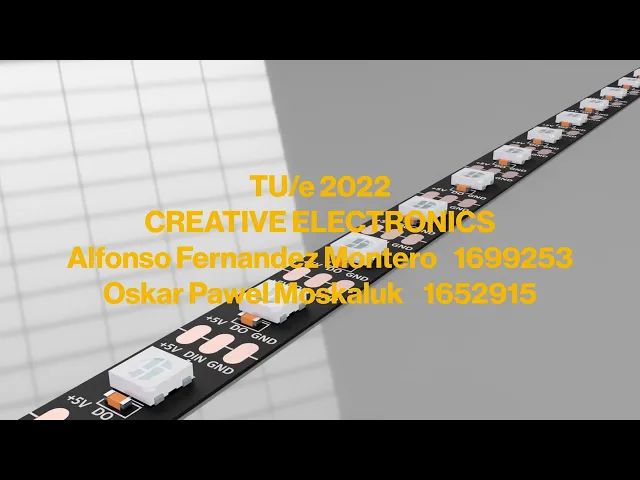
For Creative Electronics, I worked with a teammate to create a prototype for bicycle indicator lights. The project explored how electronics could improve communication between cyclists and other road users.
The prototype used electronic components, lights, circuitry, and microcontroller-based control to create a functioning indication system. Developing it required us to select components, build and test circuits, take electrical measurements, identify errors, and improve the system through iteration.
The project brought together the knowledge and practical skills developed throughout the course. Instead of building an isolated circuit, we applied electronics to a recognisable product context. This allowed us to consider how electronic behaviour could contribute to the functionality, usability, and experience of a physical product.
Reflection
Creative Electronics helped me regain confidence in working with circuits and electronic components. Before the course, I already had some practical experience with soldering, repairing electronics, upgrading speakers, and creating speaker crossovers. However, the electronics theory I had encountered in physics had made some concepts confusing and less intuitive.
The combination of weekly quizzes, practical assignments, laboratory sessions, measurements, and reports helped me rebuild my knowledge in a more structured way. Instead of learning theory separately from practice, I was able to immediately apply it by building and testing circuits.
I developed a better understanding of voltage, current, power, resistance, diodes, transistors, capacitors, thermistors, operational amplifiers, sensors, actuators, and microcontrollers. I also learned how these components can be combined to produce specific behaviours within an interactive prototype.
The laboratory sessions were especially valuable because I had previously had limited access to professional equipment. I learned how to use a multimeter, operate an oscilloscope, configure a laboratory power supply, build circuits on a breadboard, and compare measured values with theoretical calculations. These skills made electronics feel more concrete and understandable.
The bicycle indicator project allowed me to combine these individual skills in a complete system. I learned that a circuit working in theory does not always mean it will work correctly in practice. Components can be connected incorrectly, measurements may differ from calculations, and the design may need to be adjusted after testing.
A large part of my learning came from mistakes. My teammate and I often understood what had gone wrong while analysing our results and writing the report after a laboratory session. This made me realise that testing and reflection are not separate from the design process. They are necessary for understanding and improving a prototype.
Although I gained a strong foundation, there are still areas I would like to understand better, particularly inductors and the internal functioning of computer power supplies. The course gave me enough confidence and technical vocabulary to continue learning about these topics independently.
Overall, Creative Electronics was one of the most useful courses for my development as an industrial designer. It taught me how to design, construct, measure, test, and document functional electronic prototypes. It also encouraged me to integrate more electronics, sensors, actuators, and microcontrollers into my future projects.
The course showed me that technology should not be added to a product only for the sake of making it more advanced. Electronic components should support a clear function and contribute to the intended user experience. Through the bicycle indicator project, I learned how electronics can become an integrated part of an industrial design concept rather than a separate technical element.
